

How To Install Testdisk In Linux
TestDisk is a free and opensource, command-line data recovery tool that is used to recover data from deleted or lost partitions. Farther, y'all tin can apply it to revive non-bootable partitions which can be caused by factors such as accidental deletion of partition tables, and malware attacks to mention a few.
The control-line software was written in C programming languages by Christophe Granier and licensed under the GNU/GPLv2 license. TestDisk is a cross-platform tool and runs on virtually any desktop operating system: Linux, Windows, macOS, FreeBSD, OpenBSD, and even NetBSD.
What Tin TestDisk exercise?
TestDisk is a powerful, and lightweight software tool that comes with a myriad of data recovery applications as outlined below:
- TestDisk is able to repair a corrupt or damaged partition table.
- It tin can seamlessly recover a deleted disk sectionalization.
- Information technology restores files from Windows filesystems such as NTFS, FAT, FAT32, exFAT and ext2 Linux filesystem.
- It tin copy files from deleted or corrupt Windows filesystems such equally NTFS, FAT32, and exFAT and Linux partitions (ext2, ext3, and ext4).
- TestDisk can recover and rebuild the NTFS, FAT32 and FAT16 kick sectors from their backups.
- TestDisk can as well repair corrupt FAT32 tables as well equally the MFT by riding with the help of the MFT mirror.
In this article, we will show y'all how to install the TestDisk data recovery utility to recover an unbootable partition on Linux.
How to Install TestDisk on Linux
The packet TestDisk is available to install from the default organisation repositories in most Linux distribution using the default parcel manager as shown.
Install TestDisk on Debian and Ubuntu
To start off, update the system packages and install TestDisk every bit shown.
$ sudo apt update $ sudo apt install testdisk
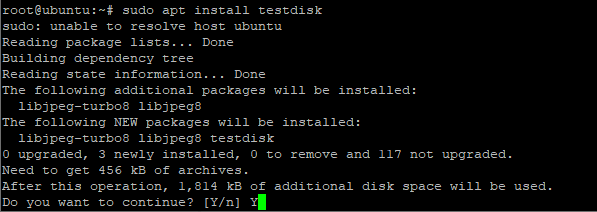
To verify that Testdisk is installed and display more information by running the following dpkg command.
$ sudo dpkg -l testdisk

Install TestDisk on RHEL and CentOS
To install TestDisk, first, enable EPEL repository and then install TestDisk equally shown.
------------ On RHEL/CentOS 7 ------------ # yum install epel-release # yum update # yum install testdisk ------------ On RHEL/CentOS viii ------------ # yum install https://dl.fedoraproject.org/pub/epel/epel-release-latest-8.noarch.rpm # yum update # yum install testdisk
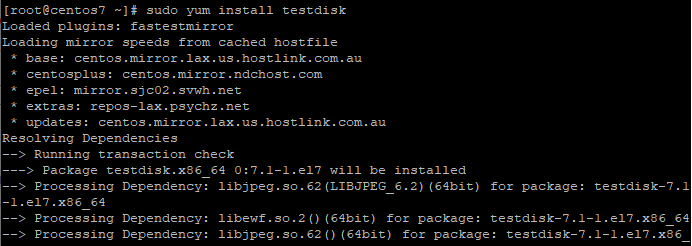
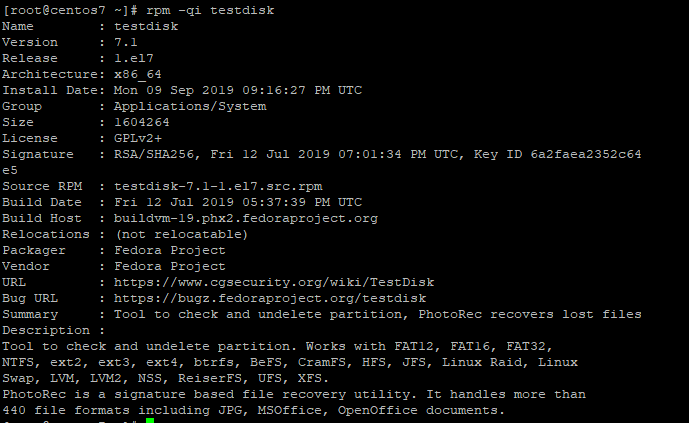
To verify that Testdisk is installed and display more information about the TestDisk tool run the following rpm control.
# rpm -qi testdisk
Install TestDisk on Fedora and Curvation Linux
For Fedora systems run.
$ sudo dnf install testdisk
For Curvation Linux run:
$ sudo pacman -S testdisk
If no suitable packet is found for your Linux distribution, download TestDisk from its official site.
How to Run and Use TestDisk in Linux
Since testdisk is run from the command line, run the command below to display the partitions on your arrangement.
# testdisk /list
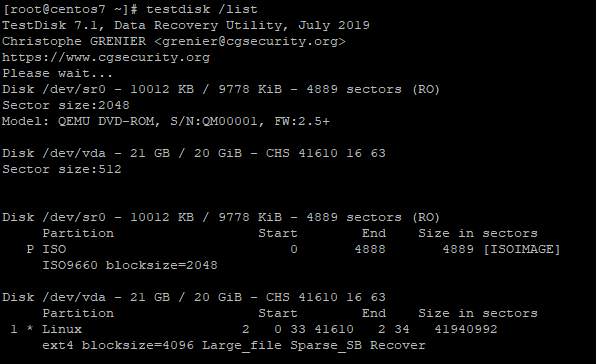
Now, assume your Linux partition table is lost or corrupt. To restore the Linux partition using TestDisk first run.
# testdisk
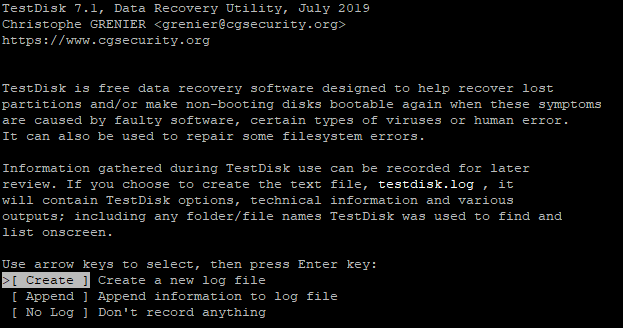
Select 'Create' and hitting ENTER. This will display a list of partitions to choose from. In your case, your partitions will be different from what is displayed below.
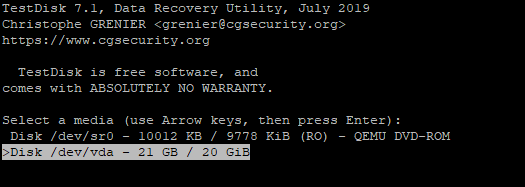
Next, select the 'Go along' at the lesser to become on to the next options.

Your organisation will automatically detect the partition table type you are using. In my case, it is 'Intel'. Hit ENTER to continue.

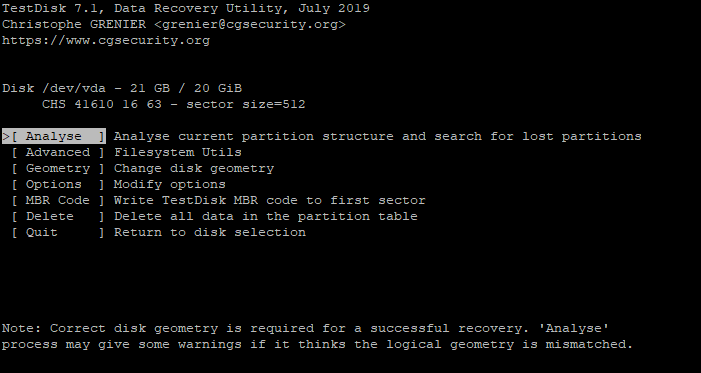
In the next department, select the 'Analyse' option for the testdisk utility to probe your partition structure.
If No bootable partition is institute on the Disk, the error below volition be printed.
Segmentation Offset Cease Size in sectors No partition is bootable *=Primary bootable P=Primary L=Logical E=Extended D=Deleted [Go on ]
Select 'Go along' selection.
A list of available partitions will exist displayed on the adjacent screen. Hitting 'ENTER' to continue to the next screen.
Select the 'write' selection on the next screen. This selection will trigger TestDisk to write on the division tabular array.
Next, press Y to confirm as shown beneath.
Write partition table, confirm ? (Y/North)
TestDsk volition prompt y'all to reboot your system for the changes to have issue.
Yous will have to reboot for the change to take effect.
Select the OK selection.
On the next screen select 'Quit' to exit the menu and finally select 'Quit' again to go out the TestDisk program.
All you have to practice now is to reboot your system. If all went well, the new partition table should allow the system to kick ordinarily.
Read Also: How to Recover Deleted Files Using TestDisk in Linux
Conclusion
TeskDisk is an platonic tool when you want to unerase data from decadent partitions or revive unbootable partitions and become them to kick as expected. It supports a vast range of file systems and can work in any operating system: from Windows to Linux.
In this guide we illustrated how to recover an unbootable partition using TestDisk, however, the tool tin can be used for then much more!
If You Capeesh What Nosotros Do Here On TecMint, Yous Should Consider:
TecMint is the fastest growing and most trusted community site for any kind of Linux Articles, Guides and Books on the web. Millions of people visit TecMint! to search or browse the thousands of published articles available FREELY to all.
If you like what you are reading, please consider buying us a coffee ( or two ) every bit a token of appreciation.

We are thankful for your never catastrophe support.

Source: https://www.tecmint.com/install-testdisk-data-recovery-tool-in-linux/
Posted by: moserthiced93.blogspot.com
0 Response to "How To Install Testdisk In Linux"
Post a Comment