

How To Repair Underground Sprinkler Line
How to Fix a Sprinkler Organization
Do-information technology-yourself solutions to irritating irrigation issues.
 Time
Time
An hr or less
 Complexity
Beginner
 Cost
Cost
Less than $20
Introduction
These simple backyard irrigation system fixes will solve 90 percent of the common breakdowns. You'll save on repair bills and keep your lawn lush and green. No special skills needed.
Tools Required
Materials Required
- Ring clamps
- Replacement heads and other parts
- Tubing repair parts
- Waterproof wire connectors
Projection pace-by-step (xi)
Pace 1
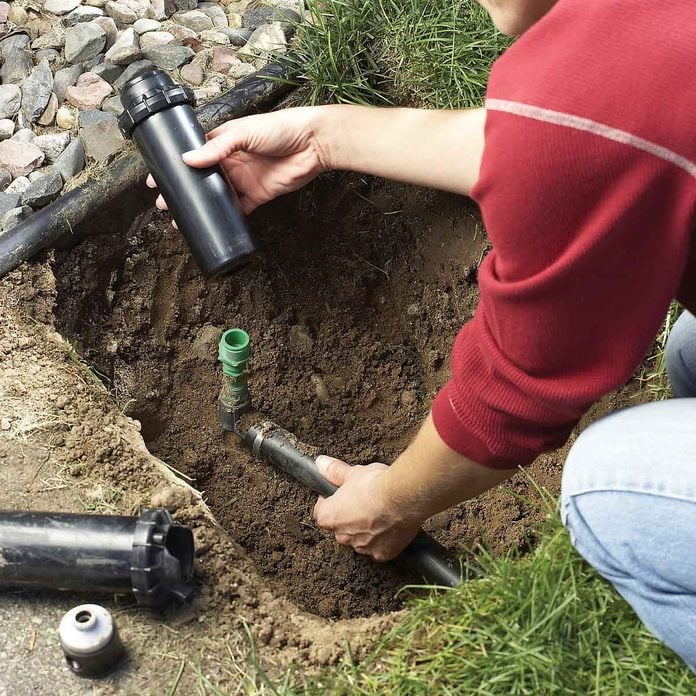
Replace a Sprinkler Head
- Dig around the sprinkler head to betrayal the riser.
- Unscrew the broken sprinkler head from the riser.
- Install the new caput, turning it tight with your hands.
Caution: Before you starting time digging to admission the underground water lines, electric wires or spray heads, dial 811 to have your secret utility lines identified and marked.
Step ii
Make clean and Reset Heads
- Disassemble the sprinkler head by unscrewing the height from the canister.
- Rinse away soil and debris in a saucepan of water.
- Remove the screen basket from the bottom of the head, so clean it with h2o.
- Adjust the watering range of the sprinkler caput before installing it. Make last adjustments with the h2o running.


Step 3
Cheque the Valves
- If you're experiencing depression water force per unit area, bank check the sprinkler organisation valves on the backflow device to brand certain they're open.
- Turn the valve on the horizontal pipage first, and so the vertical pipe valve.

Step 4
Discover and Repair Leaks
- Before making the repair, make sure the system is turned off at the controller.
- Cut out the damaged section of line.
- Place a clamp on ane of the line ends, insert a slip coupling, then tighten the clench.
- Identify a clamp on the second pipe cease, expand the coupling while inserting the nipple into the piping, then tighten the clench.

Step 5
Repair Crushed Pipes
- Dig along the water line until you find the damaged section. If the line runs nigh a tree, start your digging there.
- Once you locate the damaged section, cut it out with a hacksaw.
- If the line was damaged by tree roots, reroute the line by digging a new trench away from the tree.
- Cut a new section of piping to supersede the damaged i.
- And then supercede the section of pipe, connecting it at each end with regular couplings and band clamps.

Step 6
Check for Low Voltage
- Your watering system is divided into a series of zones.
- Generally, if you take a zone that's not turning on, you take an electrical problem.
- Make sure the zone wires are firmly attached to the terminals in the controller, the transformer is plugged in, and the circuit breaker at the main panel is on.
- Adjacent, exam for voltage to the nonworking zone, using a multimeter.
- Plow on the nonworking zone at the controller.
- Plough the multimeter dial to voltage and identify one lead on the mutual last.
- The common terminal will exist marked "c" or "com"
- Place the other lead on the terminal of the zone that'south not working.
- Refer to your possessor's manual to come across whether the voltage reading falls within the required range (usually 24 to 28 volts).
- If information technology doesn't, the controller needs to be replaced.
- Refer to your possessor's manual to come across whether the voltage reading falls within the required range (usually 24 to 28 volts).

Footstep vii
Examination the Transformer
- Exam the transformer voltage by placing the multimeter leads on the transformer terminals marked "24 vac" with the transformer plugged in.
- If the reading is less than 22, replace the transformer.

Step 8
Replace Sprinkler Solenoid
- Disconnect the wires and unscrew the defective solenoid from the control valve. Insert a new 1 and plow information technology until information technology's finger-tight.

Footstep 9
Reconnect the Wires
- Connect the ii wires on the new solenoid to the common wire and a field wire, using waterproof connectors.

Pace 10
Waterproof Connectors
- Special connectors are filled with silicone to make the connections waterproof.
- If the controller, fuse and transformer check out OK, examination the resistance "ohms" betwixt the mutual concluding and the nonworking zone.
- Turn off the organisation, plow the multimeter to test for ohms (the omega symbol), and place the leads on the common terminal and zone terminal, simply as you did to exam for voltage.
- Compare the ohms reading with the range listed in your possessor's manual (unremarkably 20 to 60 ohms).
- If the ohms fall below the required corporeality, the switch (solenoid) that operates the control valve for that zone is defective and needs to be replaced. The defective solenoid will be connected to the same colour wire as the zone wire at the controller.

Pace 11
Repair damaged wires
- If the ohms reading between the common terminal and nonworking zone concluding is too high, the problem is a severed or bad wire to the command valve.
- If but one zone isn't working, the field wire is damaged.
- If none of the zones in a command valve box is working, the common wire is damaged, although the field wires could also exist bad.
- To notice a bad wire, bypass each in plow by temporarily substituting a 14-gauge wire for the original that y'all run in a higher place ground.
- Make the wire connections with the controller turned off. Then turn the controller dorsum on.
- Examination the field wire first.
- If the zone turns on, the old field wire is bad. Supplant it with an 18-judge wire rated for underground burying. Bury the wire at least 8 inches underground.
- Follow the same procedure to test the mutual wire.
Originally Published: May 17, 2022
Source: https://www.familyhandyman.com/project/fixing-sprinkler-systems/
0 Response to "How To Repair Underground Sprinkler Line"
Post a Comment