

How To Install Basement Ceiling Lights
Installing Recessed Lighting for Dramatic Effect
Installing recessed lighting, even in the toughest situation—by angling wires.
 Time
Time
Multiple Days
 Complexity
Advanced
 Cost
Cost
$101–250
Introduction
Give your room a stunning new look and experience past installing recessed lighting. Even if you don't take access to the ceiling from the attic, you lot can install these lights by following the directions shown here. You don't have to tear upwardly your ceiling either. We'll evidence you how to add these lights to your room with minimum ceiling tear-out and patching. You tin can besides use these wiring techniques to install other types of ceiling lighting.
Tools Required
Installing recessed lighting with minimal tear-out
Dramatic lighting

Recessed fixtures cast dramatic calorie-free in the room.
Recessed lighting
The lights give the room a dramatic appearance. Thinking nearly adding recessed lights or pot lights but don't desire to tear out your whole ceiling to do it? Luckily y'all don't have to. With a piddling ingenuity and special remodeling housings, you can install a roomful of recessed lights or canister lights with minimal drywall tear-out and patching.
We'll show y'all how to install recessed lighting, the housing and fish the wires through a narrow, strategically placed slot cut in your ceiling. The techniques we'll prove yous will piece of work in nigh any situation, but if y'all're lucky enough to have access to the ceiling from the cranium, the job will exist even easier. However, this is not a projection for novices. You should know the basics of connecting wires and installing electrical boxes.
In this article, we'll exist focusing on recessed lights (aka tin lights or pot lights or canister lights), although you lot could install whatsoever other type of calorie-free fixtures using the aforementioned techniques to run the wire. Depending on your pick of fixture, lamp and trim, recessed lights tin can provide general illumination or accent lighting. In this story, we're installing a number of iv-in. diameter depression-voltage fixtures that work all-time for providing accent lighting. These operate on regular household current but have built-in transformers to power the depression-voltage element of group vii lamps. Nosotros'll show how to add a 2nd switch to command a grouping of v-in. bore recessed lights designed to provide overall illumination.
How to Install Recessed Lighting: Draw a lighting plan
This room is the end upshot of a good lighting program.
Start with a drawing and end with lighting like this. Planning ahead is the cardinal to getting the lights in the right spot. Begin past measuring your room. Using graph paper, make a scale drawing in which 1/4 in. equals 1 ft. Sketch in the article of furniture organization and any wall-mounted feature y'all'd like to accent. Decide what yous want to reach with the lights. For example, you may want to provide emphasis lighting for a favorite piece of art, add task lighting over your hobby surface area and ameliorate the general room lighting.
Take your cartoon to a lighting showroom for aid with the design. A knowledgeable lighting salesperson volition help you choose the right combination of recessed low-cal housings, trims and lamps and aid figure out the ideal locations on the ceiling. If yous experience confident in your planning ability, purchase the lights from a habitation center instead. You'll save a little money but have a smaller selection of fixtures to cull from. Brand sure to obtain an electrical allow from your local edifice department and have the piece of work inspected when you're done.
Project pace-past-step (12)
Step 1
Wiring recessed lights: Find a excursion to provide power
Cut holes in the ceiling.
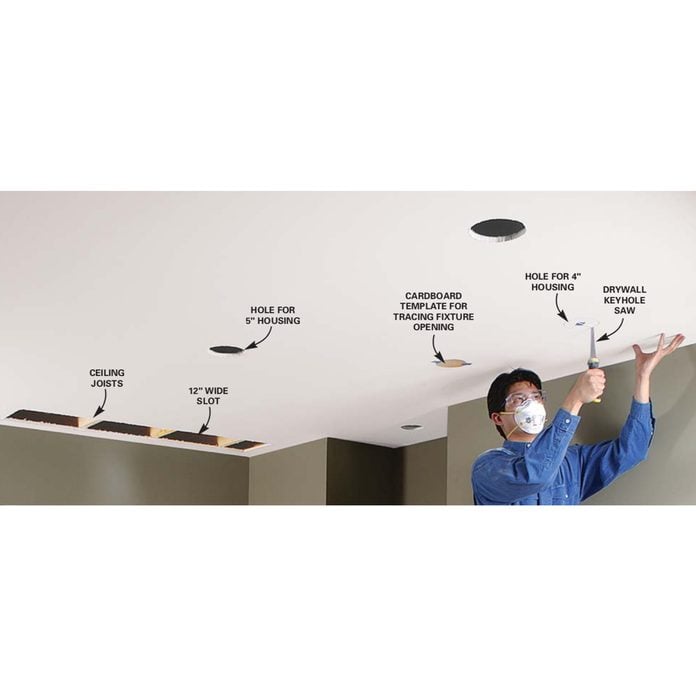
Saw a slot in the ceiling for admission to the ceiling joists and summit of the wall for wiring. And so lay out and cutting holes for the recessed light housings.
How to Build a Soffit Box with Recessed Lighting
Step 2
How to install recessed lights: Identify a power source.
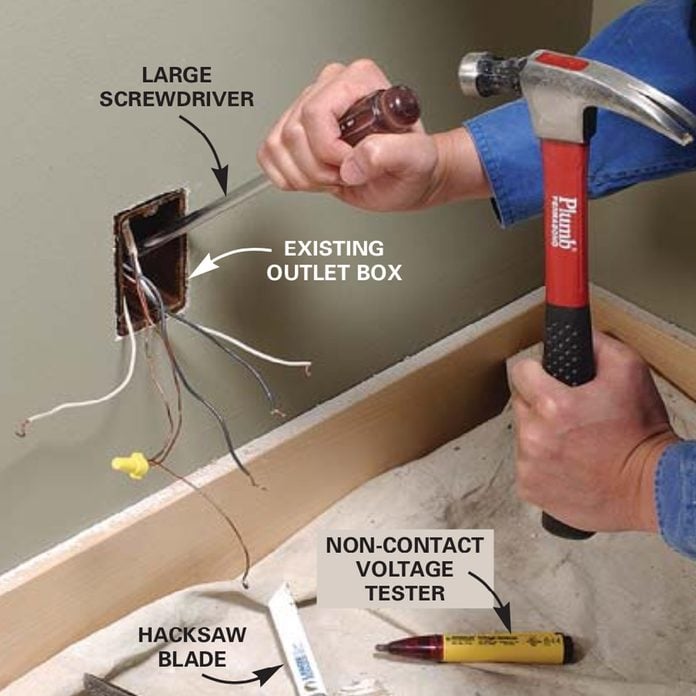
Find an existing box to utilize every bit a power source and turn off the ability to the outlet at the principal electrical panel. Break information technology out and use the hole to fish a ability cable to the new switch location.
DIY Outdoor Lighting Tips for Beginners

Step iii
How to install recessed lights: Locate your new switch box.
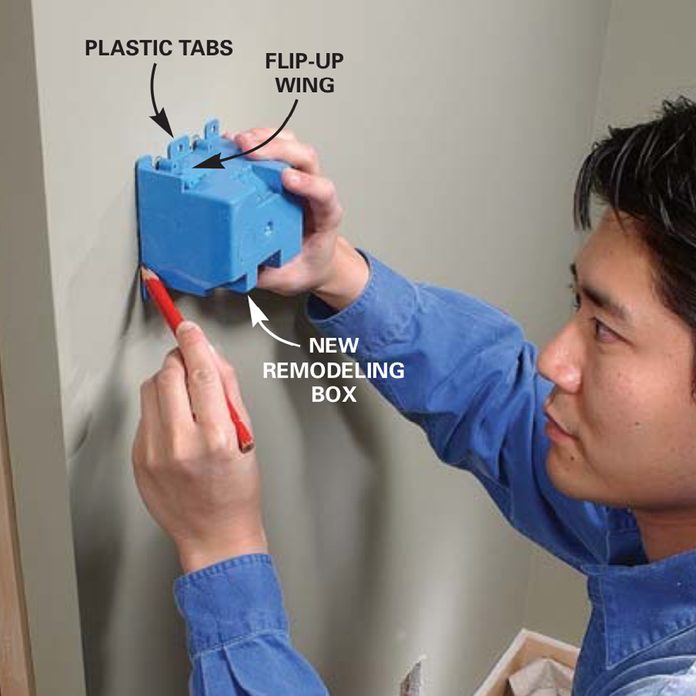
Cutting in the new switch box according to your plan (Figure A). Utilize a remodeling box that has built-in cablevision clamps. Don't mount the box until yous've pulled in cables from the ability and lights.
How to Install Deck Lighting
Step 5
How to install recessed lighting: Drill through joists.
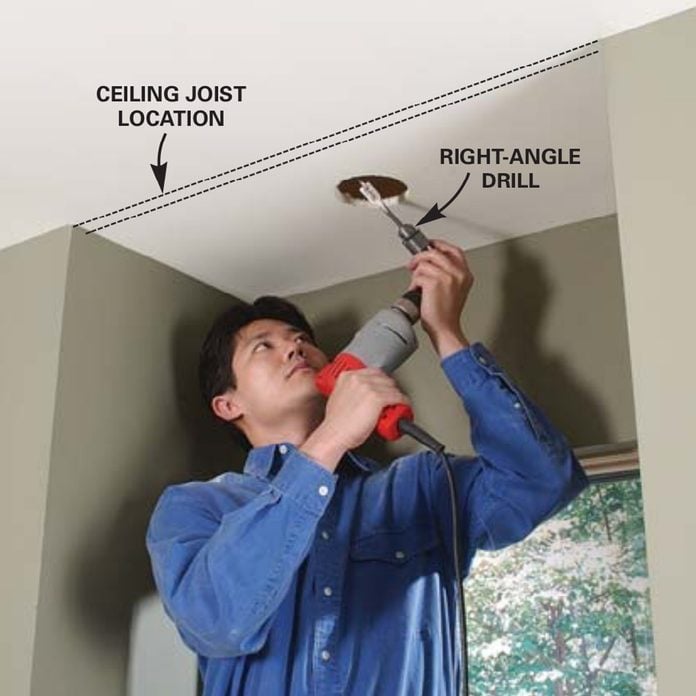
Reach through the recessed lite holes to drill through joists that aren't accessible from the slot in the ceiling. To power your new tin lights, find an existing receptacle or switch box that contains a "hot" wire on a suitable excursion. The National Electrical Lawmaking prohibits any connections to "defended" circuits such as 20-amp minor-appliance circuits in kitchens or dining areas, 20-amp laundry room circuits and 20-amp bathroom circuits.
Also brand certain the circuit y'all cull won't be overloaded by the additional lights. To determine this, first shut off the excursion in the main panel. Then go through the house turning on lights and other electrical items to find what is already on the excursion. Add up the wattage of everything that doesn't go on. Add to this total the wattage of the lights you'll be installing. We recommend a maximum connected load of 1,440 watts for a 15-amp circuit and 1,920 for a 20-amp circuit. (The amps are printed on the circuit billow or fuse.) If the full amperage exceeds these amounts, you'll accept to find a new excursion.
Try to observe a power source for your new switch that's user-friendly to fish wires from, preferably in the aforementioned wall (in either the same room or the room opposite, or a basement or attic). After you've chosen the electrical box to tie in to, turn off the excursion billow or unscrew the fuse that controls the circuit. Some electrical boxes comprise more than one circuit. Before doing any piece of work in the box, test all the wires with a non-contact voltage tester to make sure they're "dead."
Calculating Box Sizes
To effigy the minimum box size required past the National Electric Code, add: 1 for each hot and neutral wire entering the box, 1 for all the ground wires combined, one for all the clamps combined, and 2 for each device (switch or receptacle, but usually not light fixtures) installed in the box. Multiply this figure by ii for 14-judge wire and 2.25 for 12-gauge wire to get the minimum box volume in cubic inches. Plastic boxes have the book stamped inside.
CAUTION:
If you take aluminum wiring, call in a licensed pro who is certified to work with information technology. This wiring is ho-hum gray, not the dull orangish that's characteristic of copper.
Outdoor Landscape Lighting Dos and Don'ts
Step 6
Wiring recessed lighting: Remove the former box
Run a string through the receptacle opening.
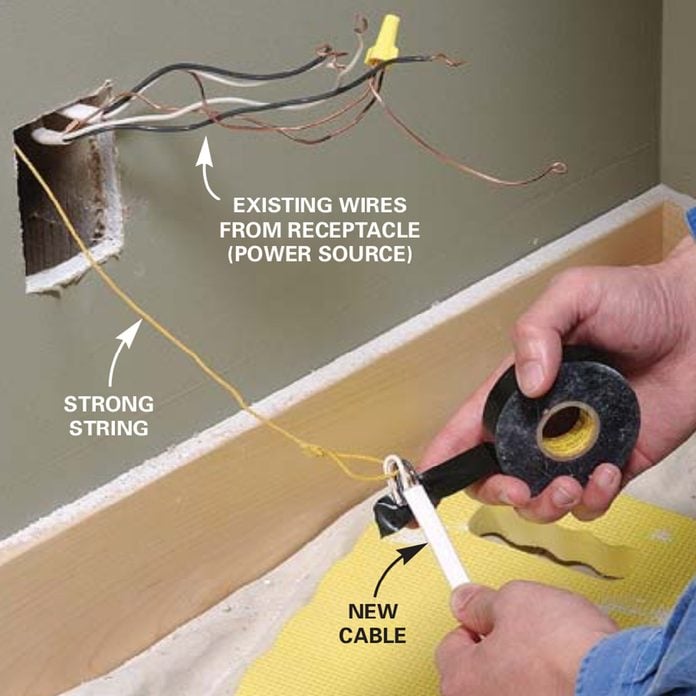
Drop a weighted string down through the hole in the top plate and record the end of the cable to it. Pull the cable up and route it over to the switch pigsty. Whether y'all choose a switch or outlet to provide power, replace the existing electrical box with a new ane. Photo 2 shows how. With the old box out of the way, you lot'll be able to use the hole to fish in the new cablevision (Photo 6). And so decide the box size required (see "Computing Box Sizes" at the end of this commodity) and install a new remodeling box that's large plenty to safely hold all the wires (Photo xi). We used a 20-cu.-in. plastic box. Make certain the new box has born cablevision clamps.
CAUTION:
If yous have aluminum wiring, call in a licensed pro who is certified to work with it. This wiring is dull grey, non the dull orange that's feature of copper.
Cut a slot for easy admission
You'll demand slots in the ceiling for the wiring and the housings.
You'll have to cut holes in the ceiling for installing recessed lighting housings. At present that you've located a source of power and have a programme showing your recessed light and switch locations, information technology's fourth dimension to effigy out how y'all'll run the cables. Start past locating the ceiling framing members (joists) with a stud finder and determining which direction they run. They're usually spaced xvi in. or 24 in. on center. Sketch the joist locations onto your lighting program. Now draw in the cable road. We installed a standard recessed light housing in the slot where we had access to the ceiling framing. In other areas, we installed remodeling housings that mount in a hole cut in the drywall.
Figure A shows how we ran the cables for our lights. Brand certain the junction boxes on the remodeling housings are listed for "through co-operative circuit wiring" then you can run at least one cablevision in and one out to the adjacent fixture. Check the labeling on the housing to be certain. Some recessed light junction boxes allow more than two cables.
If y'all don't have access to the joist spaces from the attic, remove a 12-to 16-in.broad slice of drywall from the ceiling (Photo i). Cutting the slot perpendicular to the joists nigh 6 in. out from the wall and make it long plenty to include all the joist spaces that will comprise a recessed fixture and the ability source. Ideally, the opening volition be in line with the switch and power source and then you lot tin can use information technology to drill down through the top plate (Photo 4). If not, you may have to cutting another opening.
Before you lot cut any holes, brand a minor hole and measure the depth of the joists to make sure your recessed light housings volition fit. Most housings require about 7 in. Look through the slot with a flashlight to check each joist infinite for obstructions. So measure and mark the heart of each recessed light according to your plan, adjusting the position as needed to avoid joists and other obstacles. Finally, mark and cutting the holes for the housings (Photo one).
Caution:
Some insulating materials, ceiling spray textures, plaster and articulation compounds fabricated before 1979 contain asbestos. Animate asbestos tin crusade cancer and other health issues. Phone call your local health section for information on testing for asbestos.
15 Ideas For Outdoor String Lights That Will Make You Want to Live Outside
Step 7
Wiring recessed lights: Fish the cable
Apply a fish record reel to pull cables through joist spaces.
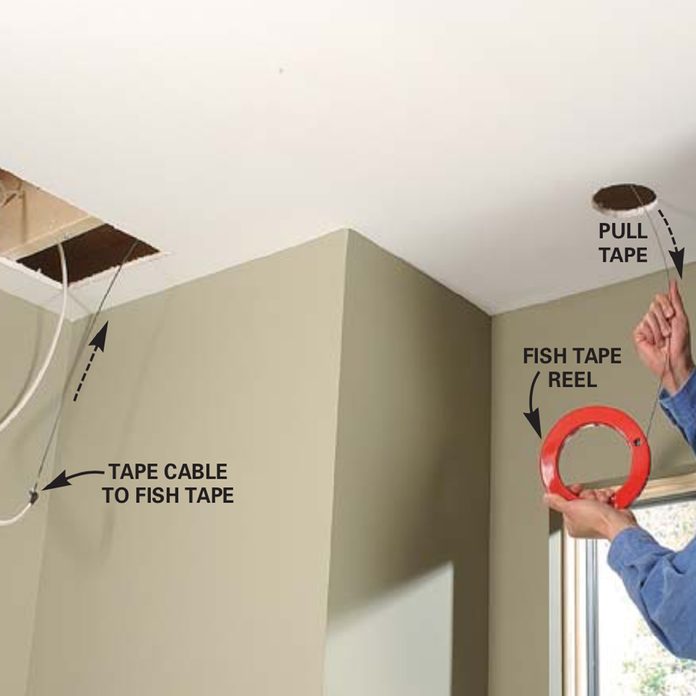
To run cables through difficult areas, record them to a metallic fish tape and pull them back through joist spaces. o run cables through hard areas, tape them to a metal fish tape and pull them back through joist spaces.
14 Outdoor Lighting Trends for 2022
Step 8
Wiring recessed lights: Connect the depression-voltage fixtures.
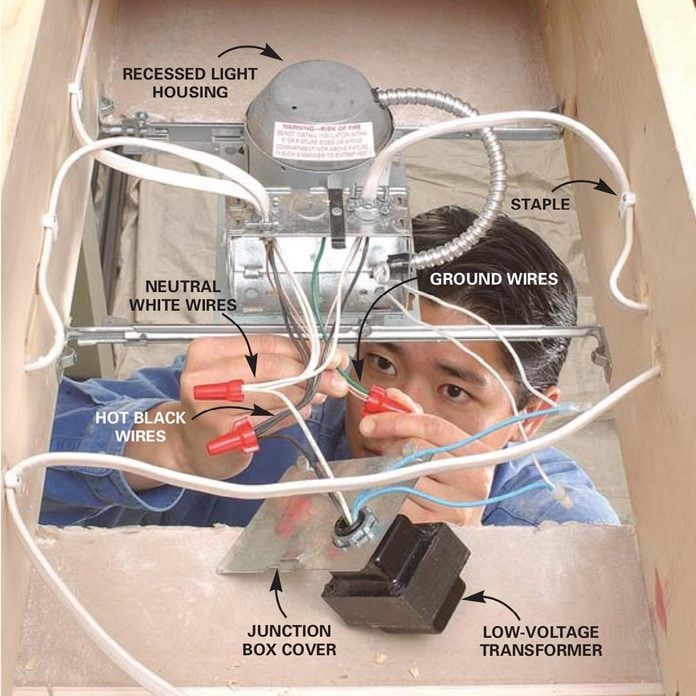
Smash upward standard "new work" housings in open ceilings. Apply the junction box on this low-voltage fixture to connect wires leading to other low voltage fixtures.
How to Achieve Amend Garage Lighting
Step ix
Wire and and then install the remodeling housings.
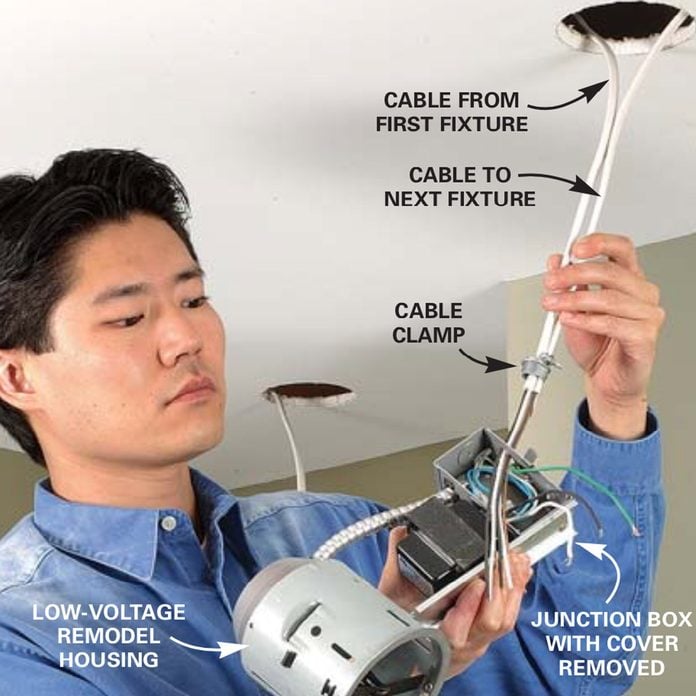
Wire remodeling housings before you slide them into the ceiling. Follow the manufacturer's instructions for wiring the fixture and mounting the box.
12 Ideas for Lighting Upwardly Your Deck
Footstep 10
Push button the cables into the remodeling box and label them.
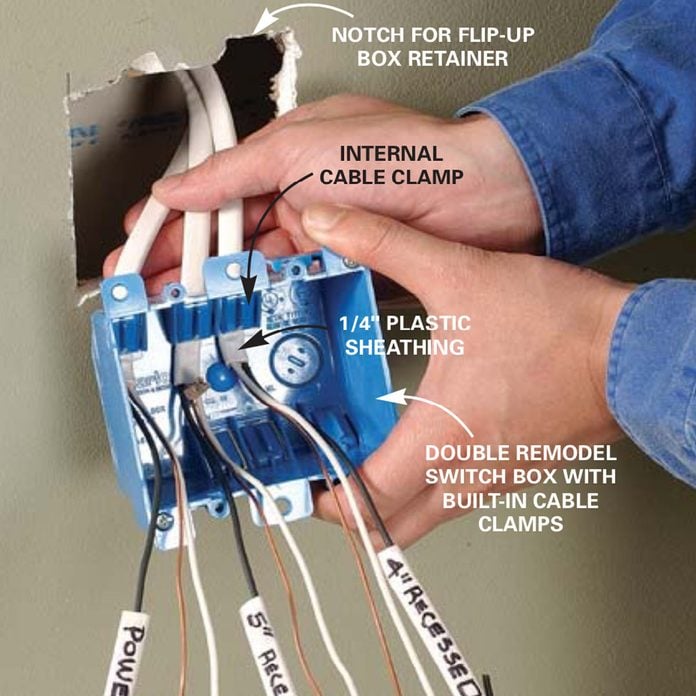
Button the ability and switch cables into the remodeling box and label them. And so slide the box into the opening and tighten the screws to secure information technology. Connect the wires according to Figure B.
ten Breathtaking Outdoor Lighting Looks For Your G
Step 11
Reconnect the outlet.

Install a new remodeling box at the old outlet location. Connect the new wires to the power source, then reconnect the outlet.
Low-Voltage Outdoor Lighting
Footstep 12
Install the trim and lamps.
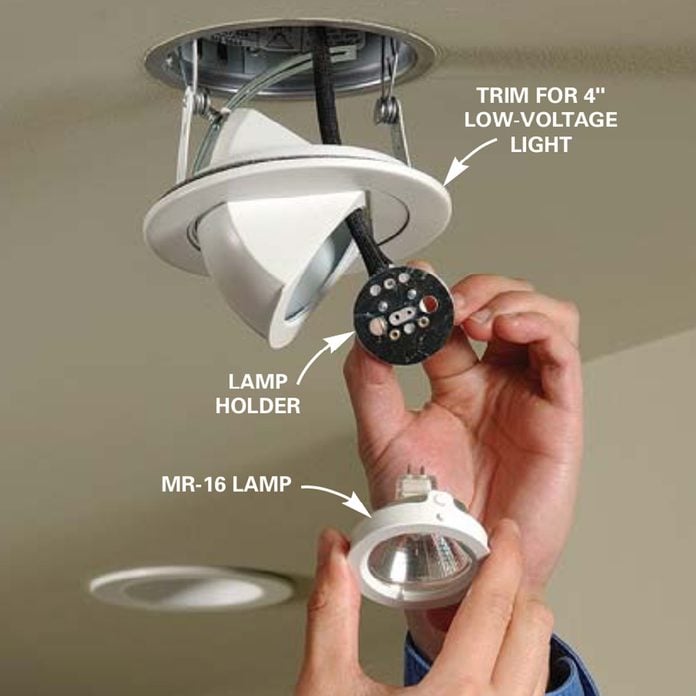
Telephone call for an electrical inspection, and then patch and paint the ceiling. Finish up by installing the trims and lamps according to your plan.
Select cable according to the circuit rating—fourteen-gauge for 15-amp and 12-gauge for 20-amp. Photos 4 – 7 evidence methods of drilling and fishing the plastic sheathed cablevision.
Here are a few tips:
- Uncoil, cut off and straighten a length of cable at least 15 percent longer than y'all recollect yous'll demand before fishing it through the framing.
- Exit about 2 ft. of extra cable at each opening.
- Staple the cable to the joists where you have access (Photo 8).
- Run merely one or two cables through each 3/iv-in. hole you've drilled. Keep holes at least two in. from the top and bottom of the joists.
- Strip 12 in. of capsule from the cable earlier sliding the cable into the electrical box. The sheathing should extend 1/four in. beyond the clamp (Photograph 10).
When yous're through running cables, make last connections at the lights, switch and receptacle (Photos 8 and 11 and Figure B) and install the remodel housings in the ceiling (Photo nine). If you're using low-voltage lights like ours and want to dim them, install a special magnetic dimmer. Replace the ceiling drywall and patch the ceiling after the electrical inspector has approved the work. Then paint the ceiling and finally install the recessed light trim and lamps (Photograph 12). Follow the instructions included with your recessed light for exact installation procedures.
Buying Recessed Lights
A recessed lite associates consists of the housing (Photos 8 and nine), trim (Photo 12) and lamp. Labels within the housing list the compatible trim styles and lamps for each. Deviating from the specifications can cause inefficient lighting, and more important, dangerous overheating.
Home centers stock a selection of basic housings and trim that cost from $xx to $40 depending on manner. You'll have to special-order less-common lights similar the four-in. low-voltage fixtures nosotros're using. Lighting showrooms usually take a wider selection and salespeople who can help you design your lighting and order the fixtures. Manufacturers' catalogs are another groovy source of information, including a complete list of housings, trim styles and lamps besides as design tips and technical data.
For open framing, buy standard housings that include mounting brackets (Photo 8). If yous're fishing wires into an existing ceiling, buy remodeling housings (Photograph 9). Make sure to buy IC (insulation contact) rated housings if your recessed lights will be covered with insulation. Non-IC housings crave a one/2-in. minimum separation from combustible textile and a 3-in. minimum separation from thermal insulation. For extra free energy efficiency in insulated ceilings, wait for airtight housings. Low-voltage housings operate on standard 115-volt wiring but have built-in transformers that let the use of small 12-volt MR-16 lamps.
The quality of light and the ability to precisely focus the axle by changing lamp types or trim styles make low-voltage recessed can lights especially useful for accent lighting. The trade-off is higher price. Including housing, trim and lamp, the average cost of each fixture is nearly $100.
How to Install Elegant Cove Lighting
Additional Data
- Figure A: Cablevision routing
- Figure B: Switch wiring
- Learn how to soffit box with recessed lighting

Source: https://www.familyhandyman.com/project/how-to-install-recessed-lighting-for-dramatic-effect/
Posted by: moserthiced93.blogspot.com
0 Response to "How To Install Basement Ceiling Lights"
Post a Comment